
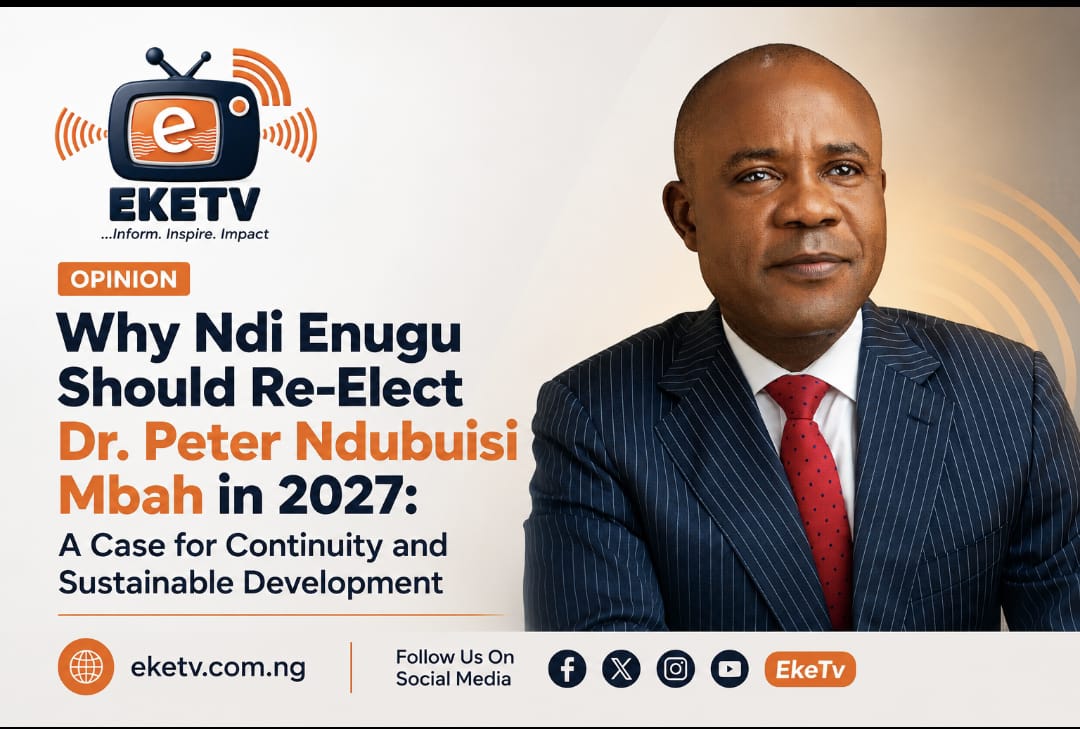
Why Ndi Enugu Should Re-Elect Dr. Peter Ndubuisi Mbah in 2027: A Case for Continuity and Sustainable Development
Why Ndi Enugu Should Re-Elect Dr. Peter Ndubuisi Mbah in 2027: A Case for Continuity and Sustainable Development
By Ike Enemoh; Eke
Enugu State stands at a defining moment in its development journey. For decades, successive administrations have spoken about unlocking the state’s vast economic potential through improved infrastructure, quality education, better healthcare, and expanded opportunities for young people. While many of these aspirations remained largely on paper, the past two years under the administration of Governor Dr. Peter Ndubuisi Mbah have, in the view of many supporters, marked a transition from promises to measurable action.
As preparations gradually begin for the 2027 governorship election, Ndi Enugu must carefully assess the progress made so far and determine the best path forward. Based on the administration’s ongoing initiatives and development agenda, there is a compelling argument for granting Governor Mbah a second term to consolidate the gains already recorded.
One of the administration’s most ambitious goals is its commitment to transforming Enugu’s economy. Governor Mbah has set a bold target of expanding the state’s economy from approximately $4.4 billion to $30 billion. Achieving such a vision requires more than political rhetoric; it demands strategic planning, investor confidence, and consistent policy implementation.
To this end, the government has focused on attracting private sector investment, improving the ease of doing business, and positioning Enugu as a destination for technology, logistics, manufacturing, and agro-processing. Initiatives such as the Enugu Smart City project and other investment-driven programs are designed to stimulate economic growth, create employment opportunities, and increase internally generated revenue. A second term would provide the continuity necessary to bring many of these long-term projects to completion and maximize their impact on the state’s economy.
Another area that has received significant attention is infrastructure and public safety. Economic growth cannot thrive without secure communities and modern infrastructure. Recognizing this, the administration has invested in strengthening security architecture while simultaneously embarking on the construction and rehabilitation of major roads across the state’s three senatorial districts.
The Maurice Akueme Foundation Releases List of 2026 Bursary Award Beneficiaries
Beyond roads, the government has prioritized investments in human capital through the establishment of 260 Smart Green Schools and 260 Type-2 Primary Healthcare Centres, with one facility planned for every political ward in the state. These projects reflect a long-term development strategy aimed at improving educational outcomes, expanding access to quality healthcare, and laying a stronger foundation for future generations.
Governor Mbah has also introduced a governance style that reflects his private-sector background. His administration emphasizes efficiency, measurable outcomes, innovation, and accountability. Rather than focusing solely on political considerations, it has sought to improve service delivery through data-driven decision-making and performance-oriented governance. Supporters argue that this approach has contributed to increased productivity within government institutions and a stronger focus on achieving tangible developmental milestones.
Continuity in leadership is another important consideration. Major infrastructure projects, including ongoing road dualization initiatives, water supply improvements, digital transformation programmes, and economic reforms, require sustained implementation over several years. A change in leadership at this stage could disrupt ongoing projects, delay execution, or alter established priorities. Allowing the current administration to complete its development agenda could ensure that the investments already made deliver their intended benefits to the people of Enugu State.
Furthermore, Governor Mbah is widely regarded by his supporters as representing a new generation of leadership. His emphasis on innovation, technology, investment, and modern governance reflects an understanding of the changing dynamics of economic development in the 21st century. For many residents who envision Enugu becoming one of Nigeria’s leading centres for business, education, tourism, and innovation, this forward-looking approach is viewed as a valuable asset.
Ultimately, every election presents citizens with an opportunity to evaluate performance against promises. As Ndi Enugu look ahead to 2027, the central question will not simply be about political affiliation but about whether the current administration has demonstrated sufficient progress to justify continuity.
Those who support Governor Peter Ndubuisi Mbah believe that the state does not need another cycle of experimentation. Instead, they argue that Enugu requires stability, consistency, and competent leadership capable of completing ongoing reforms and sustaining economic growth. If the objective is to build a state where businesses flourish, young people have meaningful employment opportunities, public services function efficiently, and development remains on an upward trajectory, then re-electing Governor Mbah for a second term, they contend, would be a vote for continuity, consolidation, and sustained progress.
Why Ndi Enugu Should Re-Elect Dr. Peter Ndubuisi Mbah in 2027: A Case for Continuity and Sustainable Development

One thought on “Why Ndi Enugu Should Re-Elect Dr. Peter Ndubuisi Mbah in 2027: A Case for Continuity and Sustainable Development”