
Diphtheria Alert at UNTH: Patients, Staff and Visitors Urged to Stay Vigilant as Enugu Steps Up Surveillance Amid Outbreak in Nigeria
Diphtheria Alert at UNTH: Patients, Staff and Visitors Urged to Stay Vigilant as Enugu Steps Up Surveillance Amid Outbreak in Nigeria
By Ike Enemoh
The University of Nigeria Teaching Hospital, Ituku-Ozalla, Enugu, has called for calm and caution following the management of a clinically suspected case of diphtheria at its Children’s Emergency Room, even as health authorities continue to monitor the disease situation across Nigeria.
In an official statement dated September 16, 2026 and signed by Dr. Charles Nonyelu, Chairman of the hospital’s Medical Advisory Committee and Director of Clinical Services and Training, UNTH said the patient was appropriately managed but sadly died two days after admission despite efforts by the attending medical team.
The hospital, however, made it clear that the case has not been established as confirmed diphtheria. According to the statement, a subsequent post-mortem review raised the possibility that the patient’s clinical presentation may instead have been caused by pharyngotonsillitis with massive exudate.
Nevertheless, UNTH said it had activated precautionary public-health measures because of the potential seriousness of diphtheria. Contact tracing is ongoing to identify and monitor people who may have had close contact with the patient, while the Children’s Emergency Room where the patient was managed has been decontaminated in accordance with established infection-prevention and control measures.
The development comes against the background of an ongoing diphtheria situation in Nigeria, where health authorities have continued surveillance and response activities following the re-emergence of the disease in the country.
For patients and visitors at UNTH, the hospital’s message is one of vigilance without panic. Management specifically appealed to patients, staff, visitors and members of the public to continue observing standard infection-prevention and control precautions while going about their normal activities.
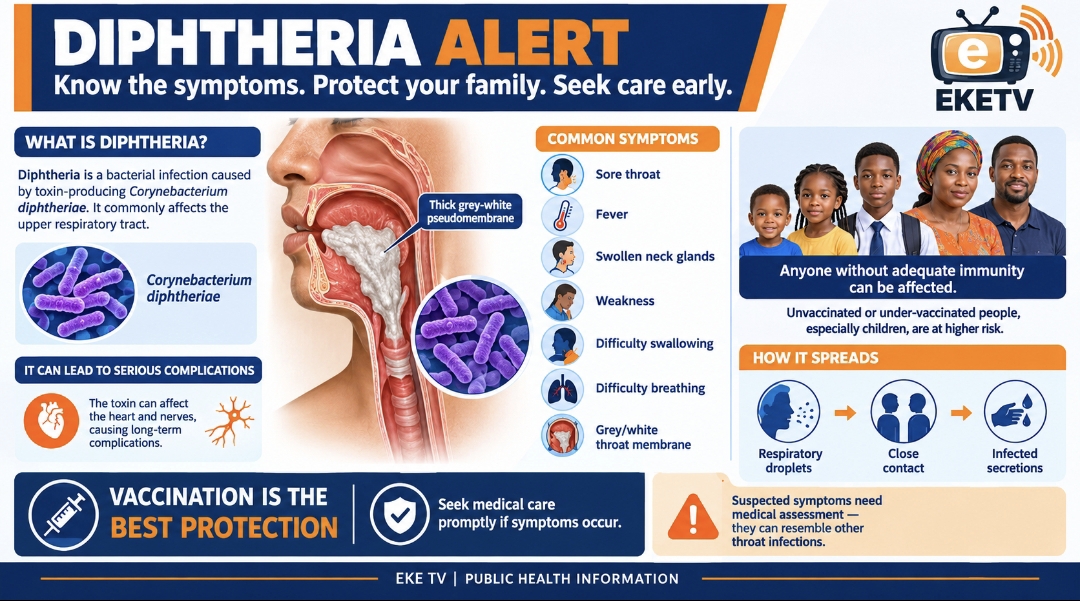
The hospital also encouraged members of the public to familiarise themselves with symptoms that may be associated with diphtheria, including fever, sore throat and difficulty swallowing, and to seek prompt medical attention if such symptoms develop.
The Enugu State Government has similarly urged residents to remain calm while maintaining vigilance. The state Commissioner for Health, Professor George Ugwu, said there is currently no confirmed case of diphtheria in Enugu State following investigation of the suspected case at UNTH. He said the state Ministry of Health’s Public Health and Surveillance Unit remained on alert for early detection and prompt response to any suspected case.
Ugwu also advised residents experiencing symptoms such as fever, sore throat, difficulty swallowing, cough, difficulty breathing, neck swelling or a greyish-white membrane in the throat to seek medical attention promptly. Parents and guardians were encouraged to ensure that children are fully immunised with vaccines containing protection against diphtheria, including the pentavalent vaccine.
The clarification from the state government is important because reports describing the UNTH incident as a confirmed diphtheria outbreak would go beyond the information contained in the hospital’s official statement.
What has been confirmed is that there was a clinically suspected case, that the patient subsequently died, and that the hospital responded with contact tracing and decontamination. The hospital’s post-mortem review subsequently raised severe pharyngotonsillitis with massive exudate as another possible explanation for the clinical presentation.
Diphtheria itself is a serious bacterial disease that can spread through respiratory droplets and close contact. It can affect the throat and other parts of the respiratory system and, in severe cases, can cause complications affecting vital organs.
The disease is vaccine-preventable, making immunisation a major component of Nigeria’s response. The current national situation has prompted continued surveillance, vaccination activities and public-health interventions in affected areas.
NCDC surveillance records show that Nigeria has continued to maintain a dedicated national response to diphtheria, with the agency publishing regular situation reports and coordinating surveillance and response activities.
The national picture also shows why health officials in Enugu are taking even a suspected case seriously. NCDC’s recent information cited by Channels Television indicates that eight states — Kano, Kaduna, Katsina, Borno, Bauchi, Plateau, Sokoto and Zamfara — account for about 98 per cent of confirmed diphtheria cases, while available vaccination information showed that approximately 68 per cent of confirmed cases involved unvaccinated people.
Although Enugu is not currently identified among the states carrying the overwhelming majority of the national burden, the state has previously recorded confirmed diphtheria. NCDC surveillance data covering an earlier period of the outbreak recorded one confirmed case in Enugu, demonstrating that the disease has previously been detected in the state.
That historical record, however, should not be confused with the present UNTH incident. The current official position from Enugu health authorities is that there is no confirmed case of diphtheria in the state arising from the latest suspected case.
The distinction between a suspected and confirmed case is particularly important in public-health reporting. Symptoms of diphtheria can overlap with other illnesses affecting the throat, which means that clinical suspicion may require further investigation before a definitive diagnosis can be made.
The UNTH case illustrates this point. While diphtheria was initially suspected, the subsequent post-mortem review raised the possibility of severe pharyngotonsillitis with massive exudate instead. The hospital nevertheless maintained precautionary measures because protecting other patients, staff and visitors remains a priority.
UNTH also stressed that sporadic cases of diphtheria have been successfully managed at the hospital in the past and that the institution has the expertise and facilities to manage such cases.
The hospital therefore urged members of the public not to allow the development to create unnecessary panic or alarm.
For patients currently receiving care at UNTH, the statement means that normal hospital activities are continuing while precautionary measures remain in place. The hospital has not announced a closure of its services as a result of the suspected case.
Staff, patients and visitors are expected to continue following standard infection-prevention and control measures, while anyone who develops concerning symptoms should seek medical assessment.
The wider national situation makes vaccination particularly important. Parents and guardians are encouraged to review the immunisation status of their children and ensure that recommended doses are received through the appropriate health facilities.
Health authorities have repeatedly stressed that vaccination remains a critical tool in preventing the spread of diphtheria, particularly among children who are among those at risk of severe disease.
The public is also advised against relying on social-media rumours or attempting to establish a diagnosis without professional medical assessment. A sore throat or fever does not by itself mean that someone has diphtheria, and several other conditions can produce similar symptoms.
At the same time, serious or worsening symptoms should not be ignored.
Difficulty breathing, difficulty swallowing, significant neck swelling, persistent fever or the development of an unusual membrane in the throat should prompt immediate medical attention.
Healthcare workers also have a crucial role in the response. Suspected cases should be recognised early, appropriate infection-prevention measures should be implemented and relevant public-health authorities should be notified promptly.
UNTH’s decision to commence contact tracing and decontaminate the Children’s Emergency Room demonstrates the importance of precautionary action when a potentially serious infectious disease is suspected.
Contact tracing can help health authorities identify people who may have been exposed, monitor them for symptoms and take appropriate action where necessary. Decontamination and infection-control measures can likewise help reduce potential risks within healthcare environments.
The incident also underscores the importance of responsible journalism during a public-health scare.
An unconfirmed case should not be presented as a confirmed outbreak, just as the absence of a confirmed case should not be interpreted to mean that health authorities should abandon surveillance.
For Eke TV News, the available evidence presents a clear picture: UNTH managed a clinically suspected case of diphtheria; the patient died two days after admission; a subsequent post-mortem review raised the possibility of severe pharyngotonsillitis with massive exudate; contact tracing and decontamination were undertaken as precautionary measures; and the Enugu State Government says there is currently no confirmed case of diphtheria in the state.
At the national level, however, the diphtheria situation remains a matter requiring sustained attention. NCDC continues to maintain dedicated surveillance for the disease, while state and federal health authorities work on case detection, reporting, response and prevention.
The immediate message to residents of Enugu is therefore not to panic, but to remain informed and vigilant.
Patients and visitors at UNTH should follow the hospital’s infection-prevention guidance. Families should ensure that children are appropriately immunised. Anyone experiencing symptoms that could indicate a serious throat infection should seek professional medical care without delay.
The current situation at UNTH is a reminder that public-health threats can require urgent precautionary action even before a diagnosis is conclusively established. It is also a reminder that accurate information is essential in preventing fear and misinformation from spreading alongside disease.
As Nigeria continues its response to diphtheria, vaccination, surveillance, early medical intervention, infection control and responsible public communication remain central to protecting communities.
For now, UNTH is calling for calm and caution, while Enugu’s health authorities maintain surveillance. The suspected case has prompted precautionary action, but it has not been officially confirmed as a diphtheria outbreak at UNTH or in Enugu State.
For Eke TV News



One thought on “Diphtheria Alert at UNTH: Patients, Staff and Visitors Urged to Stay Vigilant as Enugu Steps Up Surveillance Amid Outbreak in Nigeria”