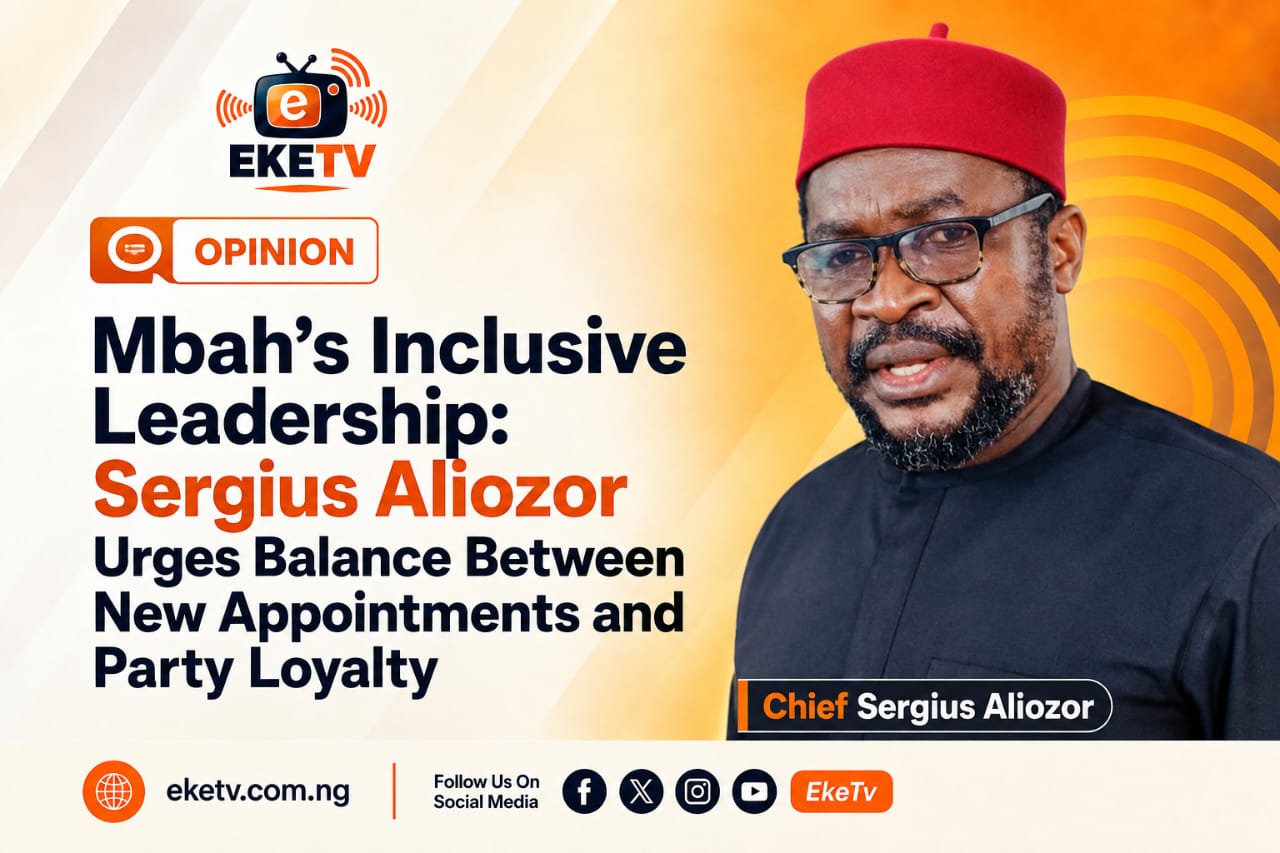
Mbah’s Inclusive Leadership: Sergius Aliozor Urges Balance Between New Appointments and Party Loyalty
Mbah’s Inclusive Leadership: Sergius Aliozor Urges Balance Between New Appointments and Party Loyalty
High Chief Sergius Aliozor has commended Enugu State Governor, Dr Peter Ndubuisi Mbah, for what he described as a demonstration of “a large heart” in his recent appointments of Senior Special Advisers and Senior Special Assistants, even as he appealed to the governor to ensure that loyal party members and grassroots supporters who stood by the administration during its political journey are not overlooked.
Aliozor’s intervention followed the governor’s latest appointments, which brought a fresh set of individuals into strategic positions across areas including labour, agriculture, infrastructure, investment, rural development, party mobilisation, public communication, tourism, social engagement, research and strategy, among others.
The appointments include Chukwudi Ezinwa as Special Adviser on Labour Union and Association Matters; Hon. Sunday Nnamani (Orlando) as Special Adviser on Special Duties; Mr Williams Chukwu as Special Adviser on Agriculture; Prince Afam Agana as Special Adviser on Infrastructure Compliance; Humphrey Onyima as Special Adviser on Investment Strategy and Public Relations; Hon. Tony Ugwu as Special Adviser on Rural Development; Chief Ernest Nweze as Special Adviser on Party Coordination and Mobilisation; Hon. Emeka Onunze as Special Adviser on Monitoring and Evaluation; and Mr Robinson Odo (mni) as Special Adviser on Labour and Productivity.
Also appointed as Senior Special Assistants are Pastor Kenneth Asogwa (Ebube Muonso), who was assigned Heritage and Community Relations; Pastor Tochukwu Ogbodo, Social Engagement; Lucky Chukwu, Public Affairs; Belonwu Nnaji, Cultural Orientation; Hon. Steve Odo, Tourism; Hon. Francis Ikewette Ede, Public Communication; Mr Sunny Okafor, General Duties; Hon. Chinedu Okwu Otaka, Social Orientation and Mobilisation; Otaba Cosmas Ikechukwu, Protection of Public Utilities; Pius Okeagu, Assets Management; Hon. Innocent Emeka Ugwu, Inter-Party Affairs; Mrs Eucharia Offor, Human Resource Management; Mr Kenneth Oforma, Policy and Communication; and Kelvin Ede, Research and Strategy.
Reacting to the development, Aliozor said Governor Mbah deserved commendation for choosing to look beyond previous political differences in assembling individuals who could contribute to the administration’s objectives.
“First, I commend His Excellency, Governor Peter Ndubuisi Mbah, for his large heart. The decision to look beyond past differences and appoint capable hands shows real leadership,” he said.
The High Chief’s position is that leadership should be broad enough to accommodate people who can bring value to government, regardless of their political history. He sees the governor’s willingness to extend opportunities beyond a narrow political circle as a sign of maturity and confidence in leadership.
However, while applauding the inclusive character of the appointments, Aliozor also urged the governor to strike a careful balance between bringing new people into government and rewarding those who have remained committed to the political structure that produced the administration.
“At the same time, I humbly appeal that as we bring others in, we should also remember and prioritize those who stood with us, campaigned with us, and are still supporting the PNM government today,” he said.
The appeal, according to Aliozor, is particularly important at the grassroots, where political loyalty is often demonstrated through years of mobilisation, community engagement and personal sacrifice.
He argued that the strength of any political organisation depends largely on the confidence of its members that their efforts will be recognised. For him, appointments should not only be viewed as instruments of governance but also as opportunities to motivate those who consistently work at the ward, community and local government levels.
“Party, politics grows stronger when participation is rewarded,” Aliozor said. “When our loyal members, ward mobilizers, and campaign foot soldiers see that commitment counts, it encourages more people to come out and work for the party.”
From the Banks of Ajali to the Ivory Tower: The Inspiring Journey of Professor Obiora John Anichebe
A Profile of Nicholas Emeka Odenigbo: A Calm, Visionary Leader Dedicated to Community Development
The statement reflects a broader concern often expressed within political circles: that grassroots supporters can become discouraged when their contributions during election campaigns are not followed by visible recognition after victory.
Campaign foot soldiers, according to Aliozor’s reasoning, are the people who often bear the burden of taking a political message to the communities, mobilising voters, attending meetings and defending the party’s interests at the local level. Their loyalty, he believes, should therefore remain an important consideration as government continues to make appointments and distribute responsibilities.
He recalled that there had been occasions in the past when party faithful became demoralised after seeing people perceived as opposition figures receive preference over those who had remained committed to the party.
“We all remember times in the past when seeing opposition figures get preference over party faithful dampened morale in many communities,” he said, expressing the hope that the Mbah administration would chart a different course.
Aliozor was careful, however, not to frame his intervention as a rejection of the governor’s latest appointments. Rather, his comments amount to an appeal for a broader balancing of interests within the administration.
His message is that inclusion and loyalty do not have to be mutually exclusive.
He believes Governor Mbah can continue to welcome people from different political backgrounds while ensuring that those who worked tirelessly for the administration and its political platform are also recognised and given meaningful opportunities to contribute.
“I believe Gov Mbah can balance both: a government of inclusion, and a government that takes care of its own,” Aliozor said. “That is how to build a stronger Enugu together.”
The recent appointments have consequently opened another conversation about the direction of the Mbah administration and the place of political inclusiveness in governance. The range of portfolios assigned to the new appointees also suggests an effort to strengthen different areas of administration and public engagement.
From agriculture and rural development to infrastructure compliance, investment strategy, labour relations, party coordination, monitoring and evaluation, the appointments cover several sectors that are central to governance and public administration.
The inclusion of portfolios such as Social Orientation and Mobilisation, Public Communication, Inter-Party Affairs, Heritage and Community Relations, and Research and Strategy also highlights the importance of communication, social engagement and political coordination in the administration’s continuing agenda.
For Aliozor, however, the success of such appointments will ultimately depend not only on the competence of those selected but also on the confidence they inspire among the wider political family.
His intervention therefore carries a message of support, caution and expectation: support for Governor Mbah’s inclusive approach, caution against allowing loyal party members to feel abandoned, and an expectation that the administration will continue to create room for those who have contributed to its political success.
At the heart of his position is the belief that political loyalty should have meaning and that grassroots participation should be encouraged rather than taken for granted.
The High Chief’s comments also come against the backdrop of Governor Mbah’s broader emphasis on transforming Enugu through institutional, economic and social reforms. The state government has continued to highlight reforms and development initiatives under the administration’s “Tomorrow is Here” agenda, with the governor recently urging Enugu residents to take ownership of the progress recorded under his administration.
Aliozor’s appeal, therefore, is ultimately presented as part of the larger conversation about building a political and governance structure capable of sustaining that progress.
He believes that a government that combines competence with loyalty, inclusiveness with recognition, and political reconciliation with grassroots appreciation will be better positioned to build lasting support across the state.
Rather than closing the door on those who once stood on the other side of the political divide, the governor, in Aliozor’s view, can continue to extend his hand of fellowship while equally reassuring those who stood with him from the beginning that their sacrifices remain valued.
As the newly appointed advisers and assistants settle into their responsibilities, Aliozor’s message is clear: inclusiveness should strengthen, not weaken, the political family; appointments should motivate, not discourage, grassroots supporters; and governance should remain broad enough to accommodate capable hands while still remembering those whose commitment helped pave the way.
He concluded his reflection with a reaffirmation of goodwill towards the governor and the state.
Mbah’s Inclusive Leadership: Sergius Aliozor Urges Balance Between New Appointments and Party Loyalty